Automating BMI Diagnosis Coding for a New Mexico FQHC

Key Takeaways:
NextGen EMR struggles to automatically populate BMI diagnosis codes from patient vitals, creating a documentation gap for users
To assist a large New Mexico FQHC with this problem, Wuscott built automation that reviews patient vitals on every encounter, calculates BMI, and adds the correct ICD-10 diagnosis code before the claim is submitted
98,434 BMI diagnoses added in approximately 11 months across standard office visits, behavioral health encounters, lab visits, and more
Encounters touched by the automation span the full payer mix including Medicare, Medicare Advantage (Humana, UHC, Blue Cross, Aetna, Christus, Cigna, Molina), and Medicaid
The client's HRSA UDS BMI Screening rate rose from 90.19% in 2024 to 92.05% in 2025 lifting the client 22 percentage points above the national average to maintain their 1st quartile HRSA ranking, a full year of the automation in 2026 might demonstrate a higher effect.
A before-and-after analysis of reimbursement from Medicare Advantage payers yielded mixed trends with several meaningful increases while others declined
A remaining opportunity exists with clinicians adding the E66.01 code for enabling HCC 48 classification.
Background
Federally Qualified Health Centers (FQHCs) carry one of the most demanding environments in healthcare. They serve complex patient populations, including Medicare and Medicaid beneficiaries, uninsured patients on sliding fee schedules, and patients enrolled in Medicare Advantage plans through commercial payers like Humana, United Healthcare, Blue Cross, and others. Medical documentation gaps can result in financial consequences and affect quality scores.
Documenting Body Mass Index (BMI) in clinical records provides an objective screening measure for human adiposity and health risk. Accurate recording helps track chronic disease trends, guides medical decisions, justifies therapy approvals with insurance providers, and supports precise risk-adjustment coding. For Medicare Advantage patients, elevated BMI, particularly morbid obesity classified under ICD-10 code E66.01, maps to Hierarchical Condition Category (HCC) 48 under the CMS V28 risk model. HCC risk scores determine how much Medicare Advantage plans are paid to cover their members, and those plans rely on provider documentation to capture each patient's true clinical complexity. When a condition like obesity is present but undocumented, the risk score is understated, and the financial opportunity is lost.
BMI also feeds directly into HRSA's Uniform Data System (UDS) quality measures. Every FQHC is required to report BMI Screening and Follow-Up Plan performance annually, and HRSA uses these scores to rank health centers nationally by quartile. Poor performance affects HRSA recognition, grant evaluations, and quality incentive payments. For 2026, the CMS V28 risk model runs at full weight for the first time, making accurate BMI documentation more financially significant than in any prior year.
Despite all of this, NextGen EMR struggles to translate a patient's recorded weight into a BMI diagnosis code on the encounter for the provider. The vitals are documented and the data can be easily interpreted for a correct diagnosis. But without a manual step or an automated process to bridge that gap, the BMI diagnosis can fail to make it onto the claim and in the record.
Wuscott's client, one of the largest community health organizations in New Mexico serving hundreds of thousands of patients across dozens of locations, recognized this gap and engaged Wuscott to solve it at scale without replacing any existing systems or disrupting clinical workflows.
The Automation: Closing the NextGen BMI Gap :
Every encounter at an FQHC produces vitals. Height and weight are recorded as a standard part of every patient visit. What NextGen does not do is take that height and weight and automatically populate the corresponding BMI diagnosis code on the claim. That step falls to staff, and at scale it is simply not happening consistently.
The Solution:
Wuscott built an automation that runs continuously against the client's NextGen environment. The bot identifies encounters that have height and weight documented in the vitals but no BMI diagnosis code on the claim. It calculates the BMI from the recorded measurements, maps it to the correct ICD-10-CM Z68 diagnosis code using NIH/NHLBI thresholds, and adds the diagnosis to the encounter before the claim is submitted. The process runs 24/7, requires no changes to clinical workflows, and operates entirely within the client's existing systems.
The Impact: :
98,434 BMI diagnoses added from September 2025 through July 2026
Monthly volume grew from approximately 3,000 encounters in September 2025 to nearly 13,000 in July 2026
Encounters spanned the full CPT mix, most commonly standard office visits 99214 and 99213, behavioral health integration, FQHC mental health visits, lab encounters, and more
BMI diagnoses are now accurately and automatically documented across Medicare FQHC, Medicare Advantage, Medicaid FQHC, and commercial payers
Zero disruption to clinical staff or existing billing workflows
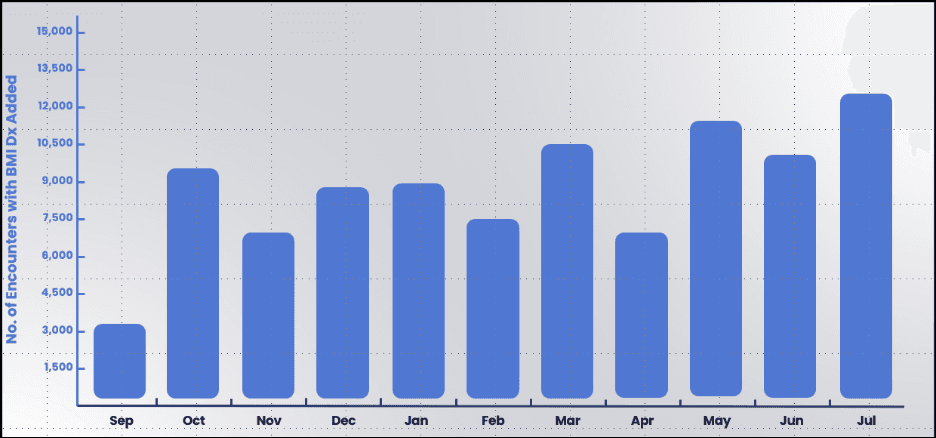
Figure 1. Number of encounters where Wuscott’s automation added the missing BMI diagnosis code based on vitals recorded during the visit.
Financial Scale and Medicare Advantage Trends
From the 98,434 encounters with a BMI diagnosis added, 72,609 of those received payment activity. Among the $82.4 million in billed charges, $12.3 million in payments were received. These figures represent the financial scale of the encounters Wuscott worked, not a direct attribution of revenue to BMI coding.
Coding BMI is necessary as part of general office visits, therefore Wuscott reviewed payments for CPTs 99213 and 99214 before and after the automation. The difference was small and rather surprising, as we noted a 0.7% decrease in payment with 99213 and a 0.6% decrease with 99214.
Average Payment Per Encounter Before and After BMI Automation in Office Visits:
CPT | Period | No. of Encounters | Total Paid | Avg. Payment/ Encounter |
|---|---|---|---|---|
99213 | After BMI Bot (Sept 2025 to July 2026) | 17,102 | $1,231,443.69 | $71.99 |
99213 | Before BMI Bot (Sept 2024 to Aug 2025) | 25,796 | $1,871,199.21 | $72.52 |
99214 | After BMI Bot (Sept 2025 to July 2026) | 36,660 | $3,679,785.31 | $100.36 |
99214 | Before BMI Bot (Sept 2024 to Aug 2025) | 42,723 | $43,13,562.34 | $100.93 |
A before-and-after analysis of average payments per encounter on the same standard office visit codes across Medicare Advantage payers showed a mixed picture following the bot deployment. Several payers trended meaningfully upward while others declined. This is consistent with normal payer rate variation, encounter mix shifts, and the reality that HCC risk adjustment benefits accumulate over annual cycles rather than showing up immediately in individual claim payments.
Payers with Directional Payment Increases (99213 / 99214, Before vs. After Bot Deployment):
Payer | Before Avg Paid | After Avg Paid | Change |
|---|---|---|---|
Christus Health Medicare Advantage | $90.14 (N=50) | $99.77 (N=77) | +10.7% |
Cigna Medicare Services | $81.44 (N=46) | $90.39 (N=23) | +11.0% |
UHC Wellmed Medicare | $87.59 (N=120) | $103.99 (N=122) | +18.7% |
United Healthcare Medicare Solutions | $49.81 (N=544) | $55.63 (N=679) | +11.7% |
Payers with Directional Payment Decreases (99213 / 99214, Before vs. After Bot Deployment):
Payer | Before Avg Paid | After Avg Paid | Change |
|---|---|---|---|
Medicare Novitas FQHC | $55.33 (n=264) | $50.52 (N=215) | -8.7% |
Novitas Medicare NON FQHC | $88.87 (N=278) | $84.31 (N=214) | -5.1% |
Tricare For Life | $103.68 (N=89) | $95.96 (N=45) | -7.4% |
Medicare FQHC | $41.67 (N=386) | $25.32 (N=456) | -39.2% |
The payers showing decreases are not cause for concern about the automation itself. Medicare and Novitas rate variations are consistent with CMS fee schedule adjustments that occur independently of diagnosis coding. The Medicare FQHC decline in particular reflects a significant drop in encounter volume suggesting a contract or coverage change rather than a coding impact. Tricare and Novitas NON FQHC show modest single-digit decreases well within normal payer rate fluctuation. None of the decreasing payers show a pattern that would suggest BMI coding caused or contributed to reduced payments.
The full picture reinforces why these trends warrant continued monitoring over time rather than definitive conclusions. HCC risk adjustment impacts accumulate over annual cycles and the most meaningful financial signal will emerge as the 2026 V28 model matures.
UDS Quality Measure Performance
Every FQHC must report BMI Screening and Follow-Up Plan performance annually to HRSA through the Uniform Data System. HRSA uses these scores to rank health centers nationally by quartile, and performance directly affects grant recognition and quality incentive payments.
The client's UDS BMI screening rate had been essentially flat for four consecutive years, holding between 90.10% and 90.19% from 2021 through 2024. In 2025, the year the Wuscott automation went live in September, that rate increased to 92.05% representing the largest single-year increase in the five-year window. It is worth noting the national FQHC average for the same measure experienced a similar increase from 2024 through 2025.
BMI Screening and Follow-Up Plan — 5-Year Performance (UDS Table 6B):
Payer | 2021 | 2022 | 2023 | 2024 | 2025 |
|---|---|---|---|---|---|
Client | 90.12% | 90.10% | 90.11% | 90.19% | 92.05% |
Client HRSA Quartile Rank | 1st | 1st | 1st | 1st | 1st |
New Mexico Average | 72.54% | 70.62% | 67.75% | 70.80% | 72.40% |
National FQHC Average | 61.32% | 61.04% | 67.13% | 67.63% | 69.99% |
The client maintains a 1st quartile national ranking and is more than 22 percentage points above the national FQHC average. The bot ran for only four months of the 2025 UDS reporting period. The 2026 UDS data, which will capture a full twelve months of bot activity at volumes of 10,000 to 13,000 encounters per month, is expected to show a more pronounced impact.
Remaining Financial Opportunity
Of the 98,434 correctly identified and added BMI diagnosis codes, 9,826 encounters had a BMI that identified the patient as morbidly obese (Z68.41 through Z68.45, corresponding to a BMI of 40 or above). However, analysis of the underlying diagnosis data revealed that only 1,073 of those encounters (10.9%) also carried the E66.01 diagnosis code which effectively maps to HCC 48 under the CMS V28 risk model. Without E66.01, the Z68 BMI code alone does not trigger HCC 48 and the risk adjustment opportunity is not captured.
HCC 48 Gap by Top Five Largest Medicare Advantage Payers:
Medicare Advantage Payer | Encounters with Morbid Obese Dx Code Added | Encounter with Added E66.01 Dx | Encounter | HCC Applicable Rate |
|---|---|---|---|---|
Humana Medicare Advantage Plan | 431 | 15 | 416 | 3.5% |
Blue Cross Medicare Advantage | 315 | 15 | 300 | 4.8% |
United Healthcare Medicare Solutions | 310 | 19 | 291 | 6.1% |
Presbyterian Medicare PPO | 222 | 14 | 208 | 6.3% |
UHC AARP Medicare Complete | 137 | 14 | 122 | 10.9% |
HCC 48 under CMS V28 carries a risk adjustment factor of approximately 0.206. For a New Mexico Medicare Advantage population, each properly documented morbidly obese patient represents meaningful additional annual capitation to the plan and plans that see better risk documentation from their FQHC partners are more likely to maintain favorable reimbursement relationships.
Across the five largest MA payers, approximately 1,337 morbidly obese patients are currently missing E66.01. Closing this gap, where clinically appropriate, represents a significant and quantifiable revenue opportunity that is currently invisible to both the provider and the payer.
Conclusion: From Gap to Foundation
Wuscott helped this New Mexico FQHC close a documentation gap that most practices may either fail to recognize or address manually, resulting in inefficiencies. In approximately 11 months, Wuscott's automation added BMI diagnoses to 98,434 encounters spanning the full payer mix and growing consistently month over month. The client's UDS BMI screening rate jumped from 90.19% to 92.05% in 2025, their largest single-year increase in five years, while maintaining a 1st quartile national ranking more than 22 percentage points above the national FQHC average. Reviewing the revenue impact for the client was negligible overall and when reviewed across
Additional impact of proper BMI coding accumulates and can be realized over time through risk adjustment cycles rather than individual claim payments. The 2026 UDS data, capturing a full twelve months of bot activity, is expected to tell an even stronger story. And the efficiency and accuracy of automation enable defensible clinical documentation where none existed before. However, an opportunity to engager the client to further understand the relevancy and applicability of adding the obesity dx codes is necessary to assure this partnership is fully realized.
If your EMR is leaving clinical documentation gaps on encounters that should be properly coded, it may be time to ask what is missing.
Lessons Learned: Know the EMR Before You Automate
The BMI coding gap in NextGen is not unique to this client. It is a structural limitation of the EMR that affects every FQHC and medical practice running NextGen at scale. Most providers accept it as a cost of doing business, manually address it inconsistently, or miss it entirely. The data to close the gap exists in the system. The problem is the bridge between clinical documentation and claim submission.
Wuscott's approach is different:
Understand the EMR limitation before writing a single line of automation
Map the exact gap between vitals documentation and diagnosis coding
Build the automation to run continuously without disrupting clinical or billing workflows
Follow ICD-10 coding guidelines precisely, including secondary diagnosis rules
Monitor volume and payer-level outcomes over time to track downstream financial impact
Meet regularly with the client to measure results and refine the process
The result is not just better documentation. It is a repeatable, defensible coding process that builds the clinical foundation needed for HCC risk adjustment and HEDIS performance on every encounter going forward.
Reach out to us for a risk-free, no-cost assessment.
Key Takeaways:
NextGen EMR struggles to automatically populate BMI diagnosis codes from patient vitals, creating a documentation gap for users
To assist a large New Mexico FQHC with this problem, Wuscott built automation that reviews patient vitals on every encounter, calculates BMI, and adds the correct ICD-10 diagnosis code before the claim is submitted
98,434 BMI diagnoses added in approximately 11 months across standard office visits, behavioral health encounters, lab visits, and more
Encounters touched by the automation span the full payer mix including Medicare, Medicare Advantage (Humana, UHC, Blue Cross, Aetna, Christus, Cigna, Molina), and Medicaid
The client's HRSA UDS BMI Screening rate rose from 90.19% in 2024 to 92.05% in 2025 lifting the client 22 percentage points above the national average to maintain their 1st quartile HRSA ranking, a full year of the automation in 2026 might demonstrate a higher effect.
A before-and-after analysis of reimbursement from Medicare Advantage payers yielded mixed trends with several meaningful increases while others declined
A remaining opportunity exists with clinicians adding the E66.01 code for enabling HCC 48 classification.
Background
Federally Qualified Health Centers (FQHCs) carry one of the most demanding environments in healthcare. They serve complex patient populations, including Medicare and Medicaid beneficiaries, uninsured patients on sliding fee schedules, and patients enrolled in Medicare Advantage plans through commercial payers like Humana, United Healthcare, Blue Cross, and others. Medical documentation gaps can result in financial consequences and affect quality scores.
Documenting Body Mass Index (BMI) in clinical records provides an objective screening measure for human adiposity and health risk. Accurate recording helps track chronic disease trends, guides medical decisions, justifies therapy approvals with insurance providers, and supports precise risk-adjustment coding. For Medicare Advantage patients, elevated BMI, particularly morbid obesity classified under ICD-10 code E66.01, maps to Hierarchical Condition Category (HCC) 48 under the CMS V28 risk model. HCC risk scores determine how much Medicare Advantage plans are paid to cover their members, and those plans rely on provider documentation to capture each patient's true clinical complexity. When a condition like obesity is present but undocumented, the risk score is understated, and the financial opportunity is lost.
BMI also feeds directly into HRSA's Uniform Data System (UDS) quality measures. Every FQHC is required to report BMI Screening and Follow-Up Plan performance annually, and HRSA uses these scores to rank health centers nationally by quartile. Poor performance affects HRSA recognition, grant evaluations, and quality incentive payments. For 2026, the CMS V28 risk model runs at full weight for the first time, making accurate BMI documentation more financially significant than in any prior year.
Despite all of this, NextGen EMR struggles to translate a patient's recorded weight into a BMI diagnosis code on the encounter for the provider. The vitals are documented and the data can be easily interpreted for a correct diagnosis. But without a manual step or an automated process to bridge that gap, the BMI diagnosis can fail to make it onto the claim and in the record.
Wuscott's client, one of the largest community health organizations in New Mexico serving hundreds of thousands of patients across dozens of locations, recognized this gap and engaged Wuscott to solve it at scale without replacing any existing systems or disrupting clinical workflows.
The Automation: Closing the NextGen BMI Gap :
Every encounter at an FQHC produces vitals. Height and weight are recorded as a standard part of every patient visit. What NextGen does not do is take that height and weight and automatically populate the corresponding BMI diagnosis code on the claim. That step falls to staff, and at scale it is simply not happening consistently.
The Solution:
Wuscott built an automation that runs continuously against the client's NextGen environment. The bot identifies encounters that have height and weight documented in the vitals but no BMI diagnosis code on the claim. It calculates the BMI from the recorded measurements, maps it to the correct ICD-10-CM Z68 diagnosis code using NIH/NHLBI thresholds, and adds the diagnosis to the encounter before the claim is submitted. The process runs 24/7, requires no changes to clinical workflows, and operates entirely within the client's existing systems.
The Impact: :
98,434 BMI diagnoses added from September 2025 through July 2026
Monthly volume grew from approximately 3,000 encounters in September 2025 to nearly 13,000 in July 2026
Encounters spanned the full CPT mix, most commonly standard office visits 99214 and 99213, behavioral health integration, FQHC mental health visits, lab encounters, and more
BMI diagnoses are now accurately and automatically documented across Medicare FQHC, Medicare Advantage, Medicaid FQHC, and commercial payers
Zero disruption to clinical staff or existing billing workflows
Figure 1. Number of encounters where Wuscott’s automation added the missing BMI diagnosis code based on vitals recorded during the visit.
Financial Scale and Medicare Advantage Trends
From the 98,434 encounters with a BMI diagnosis added, 72,609 of those received payment activity. Among the $82.4 million in billed charges, $12.3 million in payments were received. These figures represent the financial scale of the encounters Wuscott worked, not a direct attribution of revenue to BMI coding.
Coding BMI is necessary as part of general office visits, therefore Wuscott reviewed payments for CPTs 99213 and 99214 before and after the automation. The difference was small and rather surprising, as we noted a 0.7% decrease in payment with 99213 and a 0.6% decrease with 99214.
Average Payment Per Encounter Before and After BMI Automation in Office Visits:
CPT | Period | No. of Encounters | Total Paid | Avg. Payment/ Encounter |
|---|---|---|---|---|
99213 | After BMI Bot (Sept 2025 to July 2026) | 17,102 | $1,231,443.69 | $71.99 |
99213 | Before BMI Bot (Sept 2024 to Aug 2025) | 25,796 | $1,871,199.21 | $72.52 |
99214 | After BMI Bot (Sept 2025 to July 2026) | 36,660 | $3,679,785.31 | $100.36 |
99214 | Before BMI Bot (Sept 2024 to Aug 2025) | 42,723 | $43,13,562.34 | $100.93 |
A before-and-after analysis of average payments per encounter on the same standard office visit codes across Medicare Advantage payers showed a mixed picture following the bot deployment. Several payers trended meaningfully upward while others declined. This is consistent with normal payer rate variation, encounter mix shifts, and the reality that HCC risk adjustment benefits accumulate over annual cycles rather than showing up immediately in individual claim payments.
Payers with Directional Payment Increases (99213 / 99214, Before vs. After Bot Deployment):
Payer | Before Avg Paid | After Avg Paid | Change |
|---|---|---|---|
Christus Health Medicare Advantage | $90.14 (N=50) | $99.77 (N=77) | +10.7% |
Cigna Medicare Services | $81.44 (N=46) | $90.39 (N=23) | +11.0% |
UHC Wellmed Medicare | $87.59 (N=120) | $103.99 (N=122) | +18.7% |
United Healthcare Medicare Solutions | $49.81 (N=544) | $55.63 (N=679) | +11.7% |
Payers with Directional Payment Decreases (99213 / 99214, Before vs. After Bot Deployment):
Payer | Before Avg Paid | After Avg Paid | Change |
|---|---|---|---|
Medicare Novitas FQHC | $55.33 (n=264) | $50.52 (N=215) | -8.7% |
Novitas Medicare NON FQHC | $88.87 (N=278) | $84.31 (N=214) | -5.1% |
Tricare For Life | $103.68 (N=89) | $95.96 (N=45) | -7.4% |
Medicare FQHC | $41.67 (N=386) | $25.32 (N=456) | -39.2% |
The payers showing decreases are not cause for concern about the automation itself. Medicare and Novitas rate variations are consistent with CMS fee schedule adjustments that occur independently of diagnosis coding. The Medicare FQHC decline in particular reflects a significant drop in encounter volume suggesting a contract or coverage change rather than a coding impact. Tricare and Novitas NON FQHC show modest single-digit decreases well within normal payer rate fluctuation. None of the decreasing payers show a pattern that would suggest BMI coding caused or contributed to reduced payments.
The full picture reinforces why these trends warrant continued monitoring over time rather than definitive conclusions. HCC risk adjustment impacts accumulate over annual cycles and the most meaningful financial signal will emerge as the 2026 V28 model matures.
UDS Quality Measure Performance
Every FQHC must report BMI Screening and Follow-Up Plan performance annually to HRSA through the Uniform Data System. HRSA uses these scores to rank health centers nationally by quartile, and performance directly affects grant recognition and quality incentive payments.
The client's UDS BMI screening rate had been essentially flat for four consecutive years, holding between 90.10% and 90.19% from 2021 through 2024. In 2025, the year the Wuscott automation went live in September, that rate increased to 92.05% representing the largest single-year increase in the five-year window. It is worth noting the national FQHC average for the same measure experienced a similar increase from 2024 through 2025.
BMI Screening and Follow-Up Plan — 5-Year Performance (UDS Table 6B):
Payer | 2021 | 2022 | 2023 | 2024 | 2025 |
|---|---|---|---|---|---|
Client | 90.12% | 90.10% | 90.11% | 90.19% | 92.05% |
Client HRSA Quartile Rank | 1st | 1st | 1st | 1st | 1st |
New Mexico Average | 72.54% | 70.62% | 67.75% | 70.80% | 72.40% |
National FQHC Average | 61.32% | 61.04% | 67.13% | 67.63% | 69.99% |
The client maintains a 1st quartile national ranking and is more than 22 percentage points above the national FQHC average. The bot ran for only four months of the 2025 UDS reporting period. The 2026 UDS data, which will capture a full twelve months of bot activity at volumes of 10,000 to 13,000 encounters per month, is expected to show a more pronounced impact.
Remaining Financial Opportunity
Of the 98,434 correctly identified and added BMI diagnosis codes, 9,826 encounters had a BMI that identified the patient as morbidly obese (Z68.41 through Z68.45, corresponding to a BMI of 40 or above). However, analysis of the underlying diagnosis data revealed that only 1,073 of those encounters (10.9%) also carried the E66.01 diagnosis code which effectively maps to HCC 48 under the CMS V28 risk model. Without E66.01, the Z68 BMI code alone does not trigger HCC 48 and the risk adjustment opportunity is not captured.
HCC 48 Gap by Top Five Largest Medicare Advantage Payers:
Medicare Advantage Payer | Encounters with Morbid Obese Dx Code Added | Encounter with Added E66.01 Dx | Encounter | HCC Applicable Rate |
|---|---|---|---|---|
Humana Medicare Advantage Plan | 431 | 15 | 416 | 3.5% |
Blue Cross Medicare Advantage | 315 | 15 | 300 | 4.8% |
United Healthcare Medicare Solutions | 310 | 19 | 291 | 6.1% |
Presbyterian Medicare PPO | 222 | 14 | 208 | 6.3% |
UHC AARP Medicare Complete | 137 | 14 | 122 | 10.9% |
HCC 48 under CMS V28 carries a risk adjustment factor of approximately 0.206. For a New Mexico Medicare Advantage population, each properly documented morbidly obese patient represents meaningful additional annual capitation to the plan and plans that see better risk documentation from their FQHC partners are more likely to maintain favorable reimbursement relationships.
Across the five largest MA payers, approximately 1,337 morbidly obese patients are currently missing E66.01. Closing this gap, where clinically appropriate, represents a significant and quantifiable revenue opportunity that is currently invisible to both the provider and the payer.
Conclusion: From Gap to Foundation
Wuscott helped this New Mexico FQHC close a documentation gap that most practices may either fail to recognize or address manually, resulting in inefficiencies. In approximately 11 months, Wuscott's automation added BMI diagnoses to 98,434 encounters spanning the full payer mix and growing consistently month over month. The client's UDS BMI screening rate jumped from 90.19% to 92.05% in 2025, their largest single-year increase in five years, while maintaining a 1st quartile national ranking more than 22 percentage points above the national FQHC average. Reviewing the revenue impact for the client was negligible overall and when reviewed across
Additional impact of proper BMI coding accumulates and can be realized over time through risk adjustment cycles rather than individual claim payments. The 2026 UDS data, capturing a full twelve months of bot activity, is expected to tell an even stronger story. And the efficiency and accuracy of automation enable defensible clinical documentation where none existed before. However, an opportunity to engager the client to further understand the relevancy and applicability of adding the obesity dx codes is necessary to assure this partnership is fully realized.
If your EMR is leaving clinical documentation gaps on encounters that should be properly coded, it may be time to ask what is missing.
Lessons Learned: Know the EMR Before You Automate
The BMI coding gap in NextGen is not unique to this client. It is a structural limitation of the EMR that affects every FQHC and medical practice running NextGen at scale. Most providers accept it as a cost of doing business, manually address it inconsistently, or miss it entirely. The data to close the gap exists in the system. The problem is the bridge between clinical documentation and claim submission.
Wuscott's approach is different:
Understand the EMR limitation before writing a single line of automation
Map the exact gap between vitals documentation and diagnosis coding
Build the automation to run continuously without disrupting clinical or billing workflows
Follow ICD-10 coding guidelines precisely, including secondary diagnosis rules
Monitor volume and payer-level outcomes over time to track downstream financial impact
Meet regularly with the client to measure results and refine the process
The result is not just better documentation. It is a repeatable, defensible coding process that builds the clinical foundation needed for HCC risk adjustment and HEDIS performance on every encounter going forward.