Automating Revenue Cycle Management for Claims Submitted to New Mexico’s Most Critical Behavioral Health Payer

Problem: Falling Colors has some of the strictest eligibility and claim submission requirements of any payer in New Mexico, and manually managing them was resulting in misrouted claims, enrollment errors, and costly clawbacks.
Solution: Wuscott installed three purpose-built automations to ensure claims sent to Falling Colors were justified, patients were accurately enrolled in NMSTAR, and insured patients were routed to the correct payer.
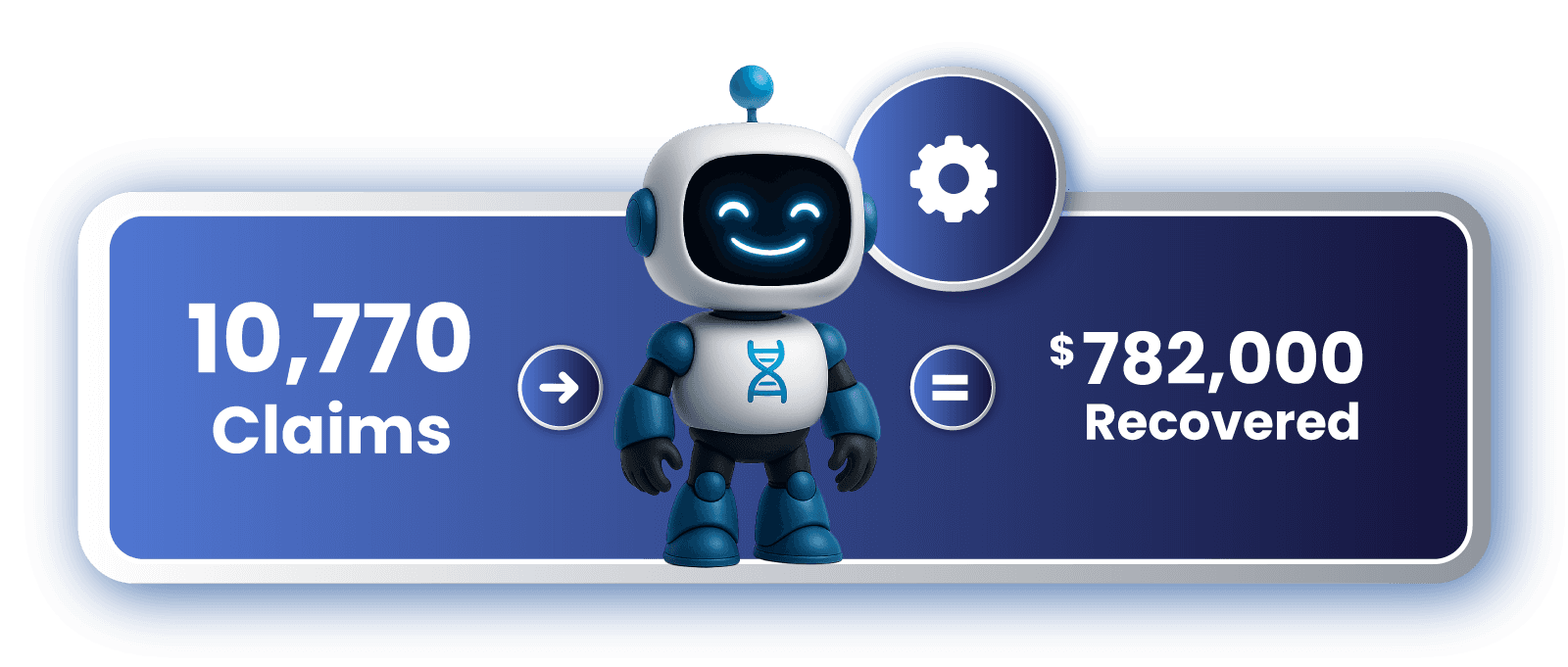
Coverage: Over 10,770 claims processed across three automated workflows in approximately 12 months.
Accuracy: Every claim reviewed for patient eligibility, NMSTAR enrollment status, and active insurance coverage before submission.
Outcome: Nearly $782,000 recovered and Falling Colors clawbacks reduced to their lowest level on record in January 2026.
Background
New Mexico’s behavioral health billing landscape is uniquely complex. Falling Colors serves as an Administrative Services Organization (ASO) for the state’s Behavioral Health Collaborative, processing payments from state general funds and federal grants for over 230 contracted providers. The platform processes over 2.5 million services to 37,000 participants annually, serving as a valuable resource for New Mexico residents who need behavioral health services but have no insurance or whose insurance will not cover behavioral health care.
Falling Colors also ensures providers receive appropriate compensation for the behavioral health services they deliver. However, billing Falling Colors is not like billing a traditional insurance payer. Three conditions must all be met simultaneously for a claim to be eligible: the service must be a behavioral health encounter, the patient must have absolutely no insurance coverage of any kind or their insurance company will not pay for behavioral health, and the claim must be filed by the last day of the month following the date of service.
Wuscott’s client, one of the largest community health organizations in New Mexico serving hundreds of thousands of patients across dozens of locations, was struggling to manage all three requirements at once. Claims were being misrouted to patients, patients were not always confirmed as enrolled in NMSTAR before billing, and the constant pressure of rolling filing deadlines created inevitable errors. Revenue was stalling, and Falling Colors was regularly recouping payments tied to patients who had insurance coverage for behavioral health services. The client turned to Wuscott to improve their Revenue Cycle Management (RCM) operations for Falling Colors billing.
This case study outlines how Wuscott deployed a three-part automation process to eliminate failure points, verify patient enrollment, and ensure every Falling Colors claim was accurate and submitted on time. The client also required that the solution work within their existing systems without disrupting clinical workflows.
First Automation:
Review Patient Bills for Falling Colors Submission
A significant volume of behavioral health claims were being sent to patients rather than Falling Colors. This typically happens when a patient has no insurance on file and the billing system defaults to patient responsibility, even when Falling Colors is a viable option.
The Solution:
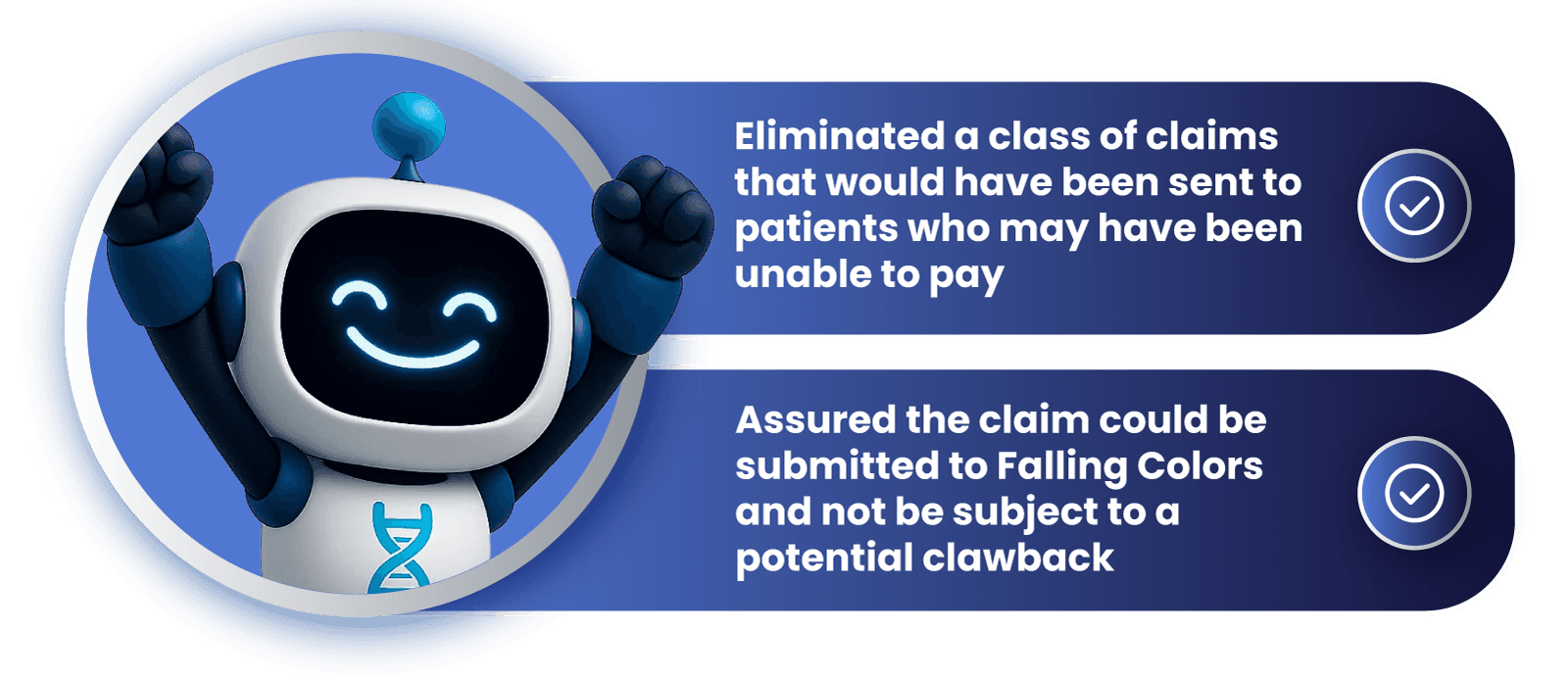
Wuscott built an automated process that identifies behavioral health claims flagged for patient responsibility. The process begins with a multi-source insurance check to confirm the patient has no coverage anywhere or no coverage for behavioral health services. If confirmed, the claim is reassigned to Falling Colors and queued for submission.
The Impact:
Second Automation:
NMSTAR Enrollment
Before Falling Colors will process a claim, the patient must be actively enrolled in NMSTAR with current demographic information and a valid identification number. Submitting a claim for a patient who is not enrolled, or whose enrollment is outdated, will result in rejection. And with a hard filing deadline set by Falling Colors, a rejected claim that misses the window may not be recoverable.
At scale, manually verifying enrollment for every behavioral health patient before every submission is cumbersome and time-consuming. Staff would spend significant time on lookups and enrollment updates, adding pressure to an already demanding filing requirement.
The Solution:
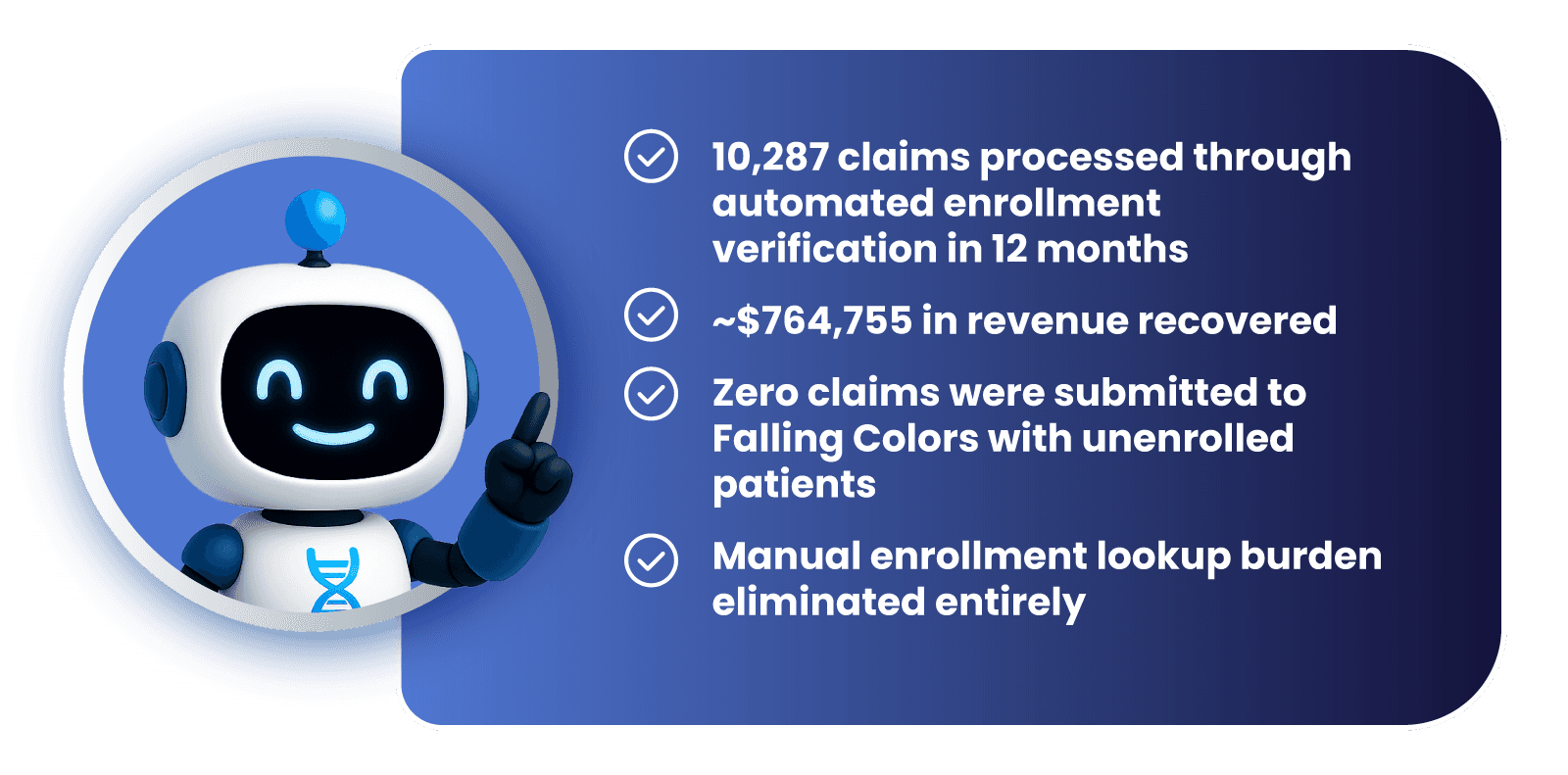
Wuscott built automation that confirms NMSTAR enrollment and, when needed, enrolls the patient with current information. Once enrollment is verified and all required claim information is in place, the automation submits the claim to Falling Colors within the required filing window.
The Impact:
Third Automation:
The Clawback Shield
As noted above, Falling Colors plays a valuable role in New Mexico’s healthcare system by ensuring providers are compensated for behavioral health services delivered to patients who have no other coverage. To protect the sustainability of the fund, Falling Colors conducts audits of its contracted providers and claims. If a provider billed Falling Colors for a patient who had active insurance coverage, those payments can be recouped.
The Solution:
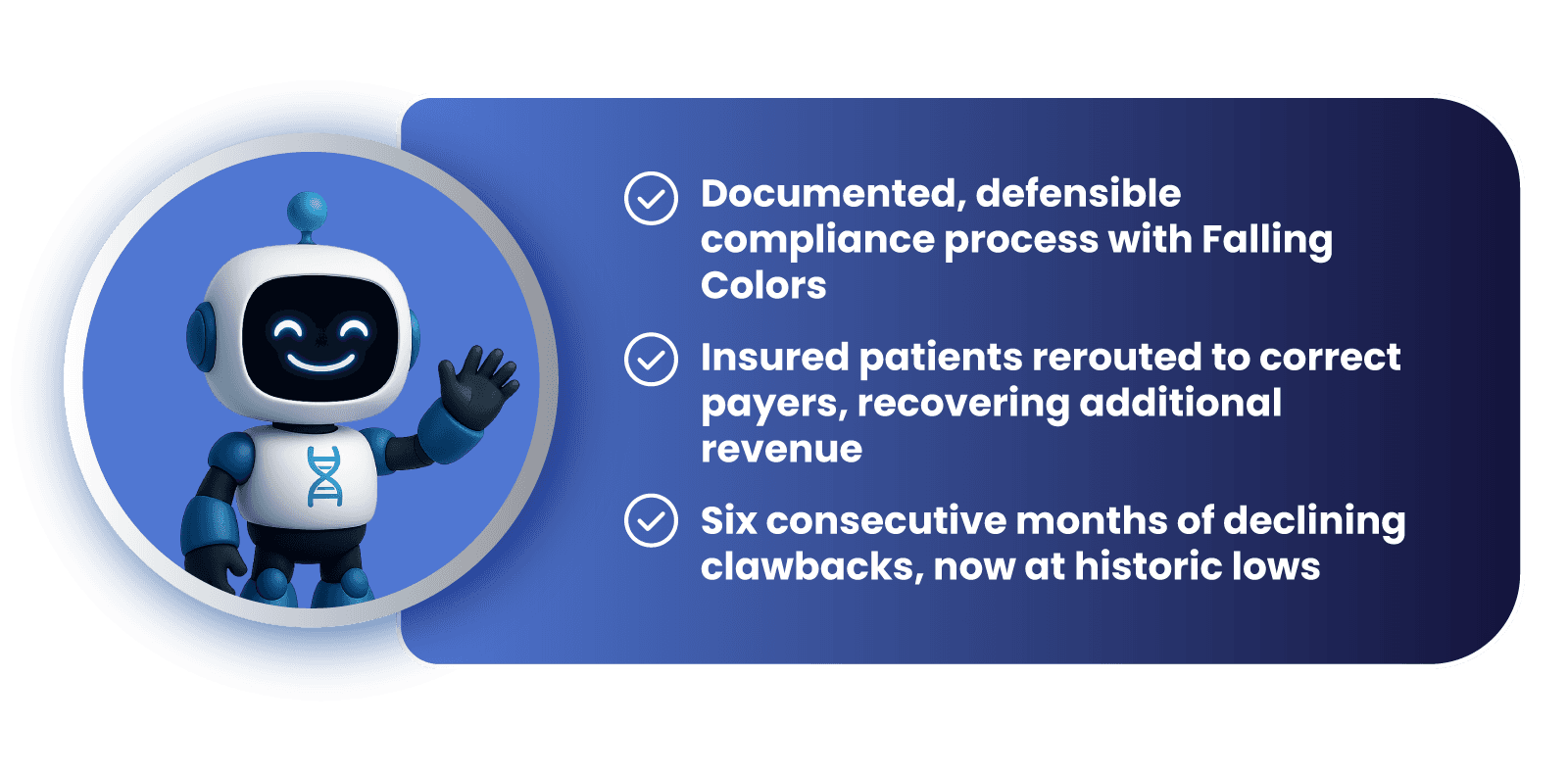
To prevent clawbacks, Wuscott installed a process to intercept claims before they reach Falling Colors. Every claim in the queue is evaluated for active insurance coverage, and if any is found, the claim is immediately rerouted to the correct payer and never submitted to Falling Colors.
The Impact:
Lessons Learned: Know the Requirements for Successful Automation
Falling Colors is a specialized payer that provides a valuable resource for communities in need. Operating within its requirements means meeting strict standards and tight deadlines that most providers try to manage manually, accept a high error rate, and quietly write off the losses as “part of doing business.”
Wuscott’s approach is different:
Understand payer eligibility rules, RCM system limitations, and provider workflows before writing a single line of automation
Map every failure point in operations such as misrouted claims, unverified enrollment, and insurance gaps
Leverage the client’s existing EMR to avoid disruptions in staffing and systems
Ensure the automation runs 24/7, never misses a filing deadline, and never skips an enrollment check
Meet regularly with the client to measure success and refine the process
The result isn’t just recovered revenue, it’s a repeatable, defensible billing process for one of New Mexico’s most crucial yet demanding payers.
Conclusion: From Exposure to Engine
Wuscott helped this New Mexico community health organization transform a chaotic, high-risk billing relationship into a clean, automated revenue engine. In approximately 12 months, the automation processed over 10,700 behavioral health claims, recovered nearly $782,000 in revenue, and drove Falling Colors clawbacks to their lowest level on record. The client only pays when Wuscott delivers results. That is how Wuscott works.
If you are billing Falling Colors manually, or if you have written off behavioral health claims assigned to patient pay because the process felt too complicated, it may be time to ask for help.
Reach out to us for a risk-free, no-cost assessment.
Problem: Falling Colors has some of the strictest eligibility and claim submission requirements of any payer in New Mexico, and manually managing them was resulting in misrouted claims, enrollment errors, and costly clawbacks.
Solution: Wuscott installed three purpose-built automations to ensure claims sent to Falling Colors were justified, patients were accurately enrolled in NMSTAR, and insured patients were routed to the correct payer.
Coverage: Over 10,770 claims processed across three automated workflows in approximately 12 months.
Accuracy: Every claim reviewed for patient eligibility, NMSTAR enrollment status, and active insurance coverage before submission.
Outcome: Nearly $782,000 recovered and Falling Colors clawbacks reduced to their lowest level on record in January 2026.
Background
New Mexico’s behavioral health billing landscape is uniquely complex. Falling Colors serves as an Administrative Services Organization (ASO) for the state’s Behavioral Health Collaborative, processing payments from state general funds and federal grants for over 230 contracted providers. The platform processes over 2.5 million services to 37,000 participants annually, serving as a valuable resource for New Mexico residents who need behavioral health services but have no insurance or whose insurance will not cover behavioral health care.
Falling Colors also ensures providers receive appropriate compensation for the behavioral health services they deliver. However, billing Falling Colors is not like billing a traditional insurance payer. Three conditions must all be met simultaneously for a claim to be eligible: the service must be a behavioral health encounter, the patient must have absolutely no insurance coverage of any kind or their insurance company will not pay for behavioral health, and the claim must be filed by the last day of the month following the date of service.
Wuscott’s client, one of the largest community health organizations in New Mexico serving hundreds of thousands of patients across dozens of locations, was struggling to manage all three requirements at once. Claims were being misrouted to patients, patients were not always confirmed as enrolled in NMSTAR before billing, and the constant pressure of rolling filing deadlines created inevitable errors. Revenue was stalling, and Falling Colors was regularly recouping payments tied to patients who had insurance coverage for behavioral health services. The client turned to Wuscott to improve their Revenue Cycle Management (RCM) operations for Falling Colors billing.
This case study outlines how Wuscott deployed a three-part automation process to eliminate failure points, verify patient enrollment, and ensure every Falling Colors claim was accurate and submitted on time. The client also required that the solution work within their existing systems without disrupting clinical workflows.
First Automation:
Review Patient Bills for Falling Colors Submission
A significant volume of behavioral health claims were being sent to patients rather than Falling Colors. This typically happens when a patient has no insurance on file and the billing system defaults to patient responsibility, even when Falling Colors is a viable option.
The Solution:
Wuscott built an automated process that identifies behavioral health claims flagged for patient responsibility. The process begins with a multi-source insurance check to confirm the patient has no coverage anywhere or no coverage for behavioral health services. If confirmed, the claim is reassigned to Falling Colors and queued for submission.
The Impact:
Second Automation:
NMSTAR Enrollment
Before Falling Colors will process a claim, the patient must be actively enrolled in NMSTAR with current demographic information and a valid identification number. Submitting a claim for a patient who is not enrolled, or whose enrollment is outdated, will result in rejection. And with a hard filing deadline set by Falling Colors, a rejected claim that misses the window may not be recoverable.
At scale, manually verifying enrollment for every behavioral health patient before every submission is cumbersome and time-consuming. Staff would spend significant time on lookups and enrollment updates, adding pressure to an already demanding filing requirement.
The Solution:
Wuscott built automation that confirms NMSTAR enrollment and, when needed, enrolls the patient with current information. Once enrollment is verified and all required claim information is in place, the automation submits the claim to Falling Colors within the required filing window.
The Impact:
Third Automation:
The Clawback Shield
As noted above, Falling Colors plays a valuable role in New Mexico’s healthcare system by ensuring providers are compensated for behavioral health services delivered to patients who have no other coverage. To protect the sustainability of the fund, Falling Colors conducts audits of its contracted providers and claims. If a provider billed Falling Colors for a patient who had active insurance coverage, those payments can be recouped.
The Solution:
To prevent clawbacks, Wuscott installed a process to intercept claims before they reach Falling Colors. Every claim in the queue is evaluated for active insurance coverage, and if any is found, the claim is immediately rerouted to the correct payer and never submitted to Falling Colors.
The Impact:
Lessons Learned: Know the Requirements for Successful Automation
Falling Colors is a specialized payer that provides a valuable resource for communities in need. Operating within its requirements means meeting strict standards and tight deadlines that most providers try to manage manually, accept a high error rate, and quietly write off the losses as “part of doing business.”
Wuscott’s approach is different:
Understand payer eligibility rules, RCM system limitations, and provider workflows before writing a single line of automation
Map every failure point in operations such as misrouted claims, unverified enrollment, and insurance gaps
Leverage the client’s existing EMR to avoid disruptions in staffing and systems
Ensure the automation runs 24/7, never misses a filing deadline, and never skips an enrollment check
Meet regularly with the client to measure success and refine the process
The result isn’t just recovered revenue, it’s a repeatable, defensible billing process for one of New Mexico’s most crucial yet demanding payers.
Conclusion: From Exposure to Engine
Wuscott helped this New Mexico community health organization transform a chaotic, high-risk billing relationship into a clean, automated revenue engine. In approximately 12 months, the automation processed over 10,700 behavioral health claims, recovered nearly $782,000 in revenue, and drove Falling Colors clawbacks to their lowest level on record. The client only pays when Wuscott delivers results. That is how Wuscott works.
If you are billing Falling Colors manually, or if you have written off behavioral health claims assigned to patient pay because the process felt too complicated, it may be time to ask for help.